Custom Software vs. SaaS: When Building Your Own Actually Pays Off
SaaS tools promise quick solutions, but the hidden costs add up. We break down when custom software is the smarter investment and how to calculate the real ROI of building your own.
Almost every business faces the same decision at some point: do we buy an off-the-shelf SaaS tool or build software that fits our processes exactly? At first glance, SaaS looks cheaper with a monthly fee, ready to use, and no development effort. But that calculation ignores the costs that only become visible over time.
This article shows you the hidden costs lurking in SaaS tools, when custom software development is the better choice, and how to make a well-informed decision for your business, with concrete examples from real projects.
The hidden costs of SaaS tools
SaaS vendors price their products so the subscription pays off for them over years, not for you. What starts as "just $49 per month" looks very different after three years. Especially when your team grows.
Per-seat licensing: the silent cost driver
Most SaaS tools charge per user per month. With 10 employees and a tool at $29/user/month, you are paying $3,480 per year for a single tool. Add CRM, project management, analytics, and accounting, and you quickly reach five-figure annual costs. For software you do not own.
Quick math: A mid-sized business with 25 employees uses 4–6 SaaS tools on average. At an average cost of $35/user/month per tool, that is $42,000–$63,000 per year, before setup, training, or integration costs.
Vendor lock-in: trapped in the ecosystem
Once your data, workflows, and processes live inside a SaaS tool, switching becomes expensive and risky. The vendor knows this and acts accordingly: price increases, feature gates behind more expensive plans, and data export hurdles are not exceptions but the norm.
Feature bloat: paying for what you never use
SaaS tools are built for the broad market. That means 80% of their features are irrelevant to your specific use case. Yet you pay for the full package, and your team has to navigate an interface designed for entirely different businesses.
When custom software is the better choice
Custom development is not always the answer. For standard tasks like email or accounting, excellent SaaS solutions exist that are hard to beat. But there are clear situations where custom software is the better investment.
- Your core processes cannot be mapped with any standard tool without workarounds.
- You are connecting multiple SaaS tools with manual steps or fragile integrations.
- License costs for your team exceed one-time development costs within 12–18 months.
- You need full control over your data, whether for compliance reasons or because your business model depends on it.
- Your competitive advantage depends on a process that no standard tool supports optimally.
Rule of thumb: if you spend more than 2 hours per week on workarounds to adapt a SaaS tool to your processes, custom software is almost always the better solution.
Real examples: how custom software pays off
The following projects show how custom software solves concrete business problems with measurable ROI.
Custom CRM instead of Salesforce & co.
A company was paying over €1,200 per month for a CRM that did far more than needed yet still did not fit their internal workflows. We built a lean, custom CRM covering exactly the required features: pipeline management, automated follow-ups, and seamless integration with existing tools. Result: zero recurring license costs, faster workflows, and full data ownership.
KPI dashboard instead of expensive BI platforms
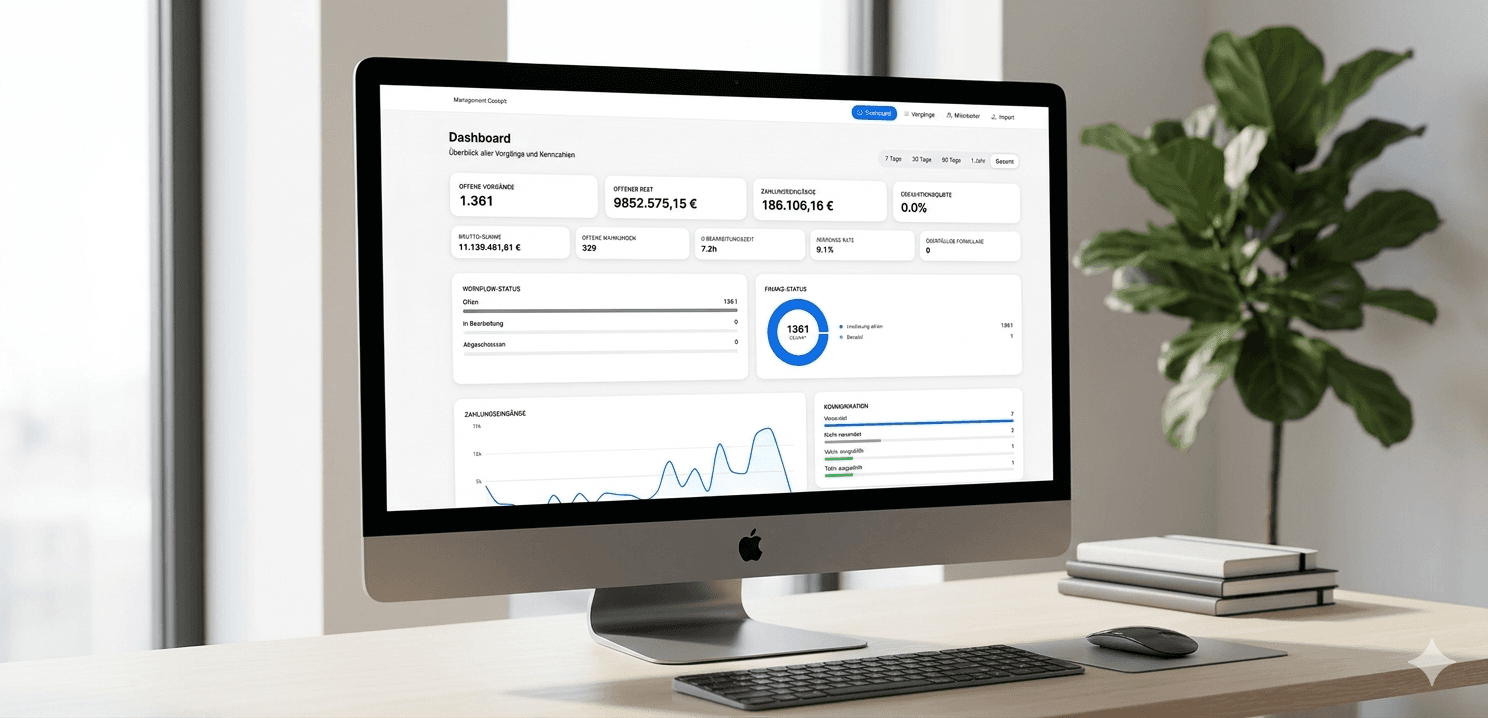
Data was scattered across CRM, marketing tools, and spreadsheets. Decisions were based on gut feeling instead of clear numbers. We built a central dashboard that consolidates all relevant data sources in real time, tailored to the company's actual KPIs. No per-user licensing, no vendor lock-in, extensible at any time.
Invoice tracking instead of spreadsheet chaos
Outstanding invoices were tracked across Excel, email, and accounting software. There was no clear overview of due dates or responsibilities. A custom tracking system centralized the entire process with automatic status tracking, reminder logic, and clear ownership. Within 2 months, 80% of outstanding receivables were collected.
The ROI calculation: build vs. buy
The build-vs-buy decision can be objectified with a simple calculation. Compare cumulative SaaS costs over 3 years (licenses + integrations + workaround time + training) against one-time development costs plus ongoing maintenance.
- SaaS over 3 years: license costs × users × 36 months + integration effort + hidden costs (data export, premium features, price increases).
- Custom software: one-time development + optional maintenance (typically 10–15% of development costs per year). No user fees, no forced upgrades.
- Break-even: for most mid-sized businesses, custom software pays for itself within 6–18 months.
Custom software is an investment, not an expense. You pay once and own the result permanently. Every month after the break-even point is pure profit compared to the SaaS alternative.
What to look for when building custom software
Building custom software is not automatic. The right execution determines success or failure. Keep these points in mind:
- Start with the Minimum Viable Product (MVP), not the perfect system. Ship fast, iterate after.
- Choose a partner who understands your business, not just writes code. The best technical solutions emerge when developers understand the underlying problem.
- Plan for scalability from the start. Your system must be able to grow with your business.
- Insist on full code ownership. No vendor lock-in, and you own everything we build.
- Build in automation and AI readiness. Your system should be prepared for future extensions.
Conclusion: the right software for your business
SaaS is not bad. It is just not always the right choice. When your core processes have individual requirements, when license costs strain your budget, or when you need full control over your data, custom software is the smarter path.
The first step? An honest analysis of your current tool landscape. What is your SaaS stack really costing you, including the hidden costs? And what would be possible if you had software that fits your business exactly?
FAQ
Frequently asked questions
Answers to the most important questions on this topic.